


Lithium Iron Phosphate (LiFePO4) batteries are known for their safety, long lifespan, and reliable performance. Understanding the LiFePO4 voltage chart is key to managing these batteries effectively. This guide explains how to read voltage levels, extend battery life, and optimize your energy storage system.
LiFePO4 Battery Voltage Basics
LiFePO4 batteries store large amounts of energy and can power various appliances. Their voltage changes with the state of charge (SOC): as the battery charges, voltage rises; as it discharges, voltage drops. Higher voltage indicates more stored energy.
Here are some key terms to help you understand LiFePO4 battery voltage more clearly.
- Nominal Voltage- The LiFePO4 battery delivers its best performance at the recommended level, 3.25V. This standard level is for monitoring the charging and discharging of the battery.
- Storage Voltage- This is the ideal voltage in which the LiFePO4 battery must be stored if not in use for a prolonged time. Storage voltage ensures good battery health and reduces capacity loss.
- Fully Charged Voltage- It ranges at 3.65V and it is the maximum voltage for charging. Charging beyond this level causes irreparable LiFePO4 battery damage.
- Discharge Voltage- Discharge optimal voltage is 2.5V. A user should never discharge under this level. Exceeding the discharge limit damages the LiFePO4 battery.
- Deep Discharge- At this point, the voltage runs below the recommended level. Deep discharge renders the LiFePO4 batteries and may render them completely obsolete.
The LiFePO4 Voltage Chart: 12V, 24V, and 48V
The LiFePO4 voltage chart enables the users to understand the recommended charge levels for safe charging. Also, it acts as a reference point for gauging battery performance and identifying the state of charge for various batteries.
Use this LiFePO4 battery voltage chart to check the charge level of your 1 Cell, 12V, 24V, or 48V battery and optimize battery usage.
| SOC (%) | 1 Cell (V) | 12V Battery (V) | 24V Battery (V) | 48V Battery (V) |
|---|---|---|---|---|
| 100% Charging | 3.65 | 14.6 | 29.2 | 58.4 |
| 100% Rest | 3.40 | 13.6 | 27.2 | 54.4 |
| 90% | 3.35 | 13.4 | 26.8 | 53.6 |
| 80% | 3.32 | 13.3 | 26.6 | 53.1 |
| 70% | 3.30 | 13.2 | 26.4 | 52.8 |
| 60% | 3.27 | 13.1 | 26.1 | 52.3 |
| 50% | 3.26 | 13.0 | 26.1 | 52.2 |
| 40% | 3.25 | 13.0 | 26.0 | 52.0 |
| 30% | 3.22 | 12.9 | 25.8 | 51.5 |
| 20% | 3.20 | 12.8 | 25.6 | 51.2 |
| 10% | 3.00 | 12.0 | 24.0 | 48.0 |
| 0% | 2.50 | 10.0 | 20.0 | 40.0 |
3.2V Battery Voltage Chart
Every lithium iron phosphate battery has a nominal voltage of 3.2V, with a charging voltage of 3.65V. The discharge cut-down voltage of LiFePO4 cells is 2.0V. Here is a 3.2V battery voltage chart.

12V Battery Voltage Chart
Thanks to its enhanced safety features, the 12V is the ideal voltage for home solar systems. It has a voltage of 14.6V at a full charge and a discharge of 10V. Below is an illustration of the 12V battery voltage.

24V Battery Voltage Chart
24V LiFePO4 batteries completely charges at 29.2V and discharges at 20V. Check the chart illustration below.

48V Battery Voltage Chart
48V LiFePO4 batteries are suitable for large solar power system installations. It keeps the amperage low and helps in saving on equipment and wiring costs.

LiFePO4 Battery Charging Parameters
The recommended charging parameters ensure optimal battery performance, good health, and durability. Every user must observe these parameters during charging. Avoid overcharging or undercharging for efficient power storage and longer lifespan. The following is a LiFePO4 battery charging parameter chart.

LiFePO4 Batteries Bulk, Float, and Equalize Voltages
LiFePO4 batteries have various voltage stages, namely: bulk, float, and equalize. During the bulk stage, the battery charges rapidly at a constant current up to a certain voltage. In the float stage, the battery maintains the voltage charge. This extends the battery's efficiency and extends its lifespan. The equalization stage balances the cells while ensuring uniform charging.

LiFePO4 Batteries: Charging and Discharging Processes
In simple terms, the cycles or the charge and discharge rates are the battery's charging patterns. These charging patterns are crucial for maintaining the health and durability of the battery. Therefore, you must observe proper and safe charging and discharging patterns. The state of charge indicates the capacity that can be discharged over the total battery capacity. The voltage increases when you charge the battery. The SOC of the battery is dependent on its charge.
Example: A 100Ah battery has a 30Ah capacity for discharging. Therefore, the SOC is 30%. If the battery charges to 100Ah and discharge 70Ah, then 30Ah remains.
Here is a lithium battery chart indicating the correlation between SOC and LiFePO4 voltage:

Does Voltage Affect LiFePO4 Battery Performance?
Yes. Voltage significantly affects various aspects of lithium iron phosphate batteries, including performance and durability. Proper knowledge of these effects will guide to proper utilization and maintenance of the battery for optimal performance.
- Capacity - The battery voltage and capacity are both proportionate. Meaning, that the voltage affects the capacity of the LiFePO4 batteries. An increase in battery voltage causes a capacity increase. Batteries with higher capacity and voltage are capable of storing a high amount of energy and charging your devices longer.
- Lifespan - LiFePO4 batteries with high voltage last longer than batteries with lower voltage. Batteries with higher voltages are capable of handling more cycles. Maintaining optimum voltage minimizes risks of thermal runaway and incomplete chemical reactions, which contributes to faster battery degradation.
- Charging - LiFePO4 battery voltage impacts its charging capabilities. Voltage-sensitive charging ensures battery safety and efficiency. Wrong voltage results in overheating or undercharging which ultimately affects the battery’s performance, health, and lifespan.
- Discharging - LiFePO4 battery voltage discharge can affect its performance. Discharging the battery below the prescribed voltage level causes permanent damage and shortens its lifespan.
- Efficiency - The LiFePO4 battery is proportional to its voltage. Therefore, a battery with a high voltage level supplies power efficiently.
How to Check LiFePO4 Battery Capacity
Keep your LiFePO4 battery performing optimally and for a long time by checking and monitoring it regularly. The following methods will enable you to measure the LiFePO4 battery capacity accurately.
- Use Multimeter - A multimeter is a specialized battery tester that ensures accurate voltage readings and battery capacity.
- Battery Monitor - This is a reliable battery testing method that provides detailed information on the battery capacity. The battery monitor evaluates battery specs such as the battery’s health, capacity, voltage, and energy discharged, and predicts the battery lifespan.
- Solar Charge Controller - The solar charge controller checks the LiFePO4 battery capacity. This method is useful for systems that have integrated solar systems.
- App Monitoring - Some batteries allow remote control and monitoring of LiFePO4 batteries. The App enables you to monitor the performance, and voltage, among other features using your smartphone.
Battery Capacity Calculation Formula: Capacity= Discharge Current (A) X Discharge Time (Hours)
LiFePO4 Batteries Recommended
Here’s a quick look at some of the top-performing LiFePO4 batteries available in the United States. Among them, Renogy’s LiFePO4 batteries stand out for their consistent quality, rigorous safety standards, and reliable performance in various applications.
1. Renogy 12.8V 100Ah LiFePO4 mini battery
Renogy 12.8V 100Ah LiFePO4 mini battery is the Renogy's smallest lithium iron phosphate battery. It comes with a low-temperature cut-off feature to ensure safe charging in freezing temperatures. You can monitor the battery stats by using it with a 300A battery shunt. Moreover, this battery is vibration-resistant and IP65-rated for an unmatched outdoor performance.
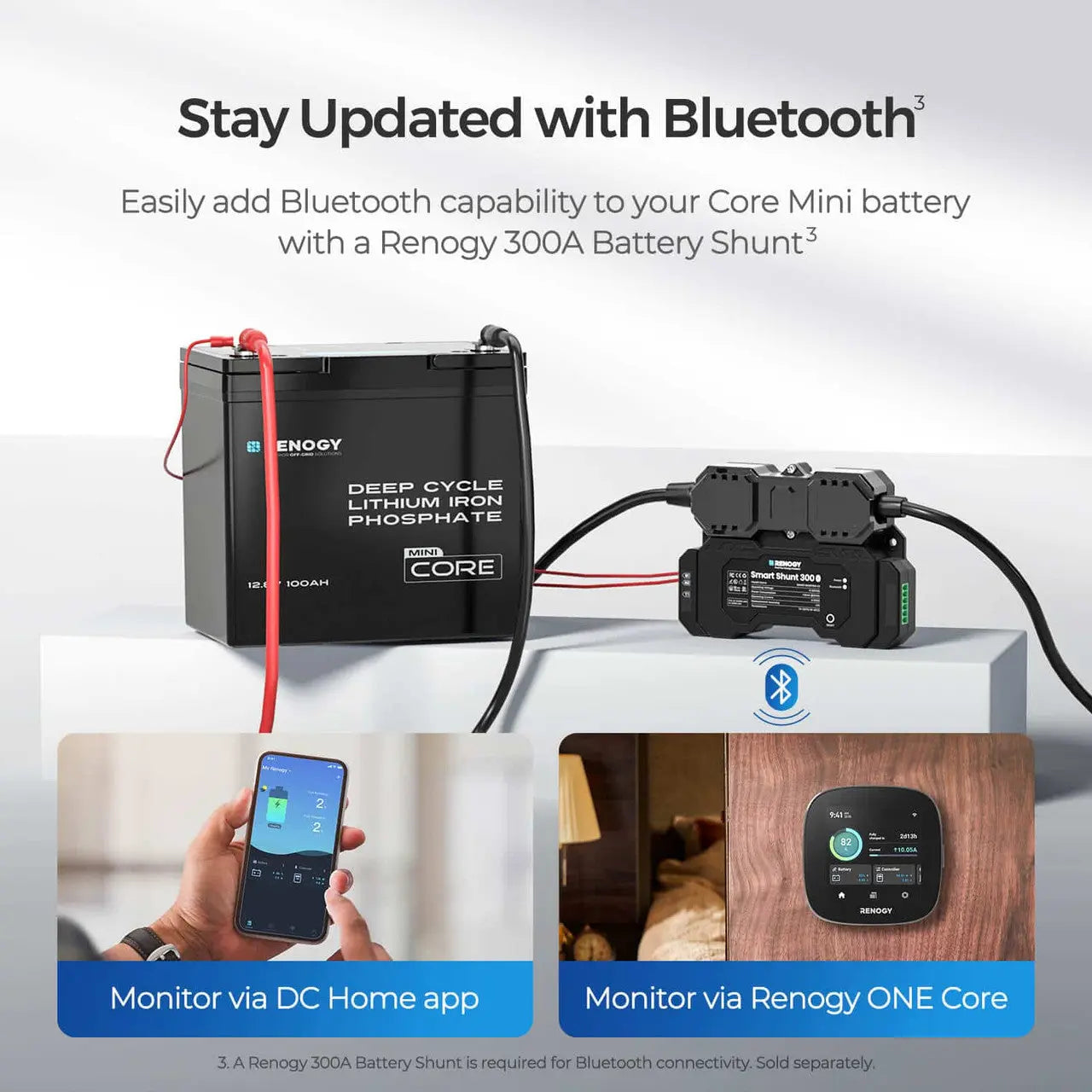
- Renogy's smallest 12.8V 100Ah LFP Battery.
- Low-temperature cut-off for safer charging in freezing weather.
- Can be mounted on its sides to fit in cramped spaces.
2. Renogy 12V 300Ah deep cycle LiFePO4 battery
Renogy 12V 300Ah deep cycle LiFePO4 battery is known for delivering 59% more power than a 200Ah same-sized lithium iron phosphate battery. It offers low-temperature protection and supports series-parallel, parallel, or series connections. The self-heating feature makes this battery a perfect choice for all-weather living. 24-hour timely assistance and 5-year product warranty adds more value to the credibility of this battery.
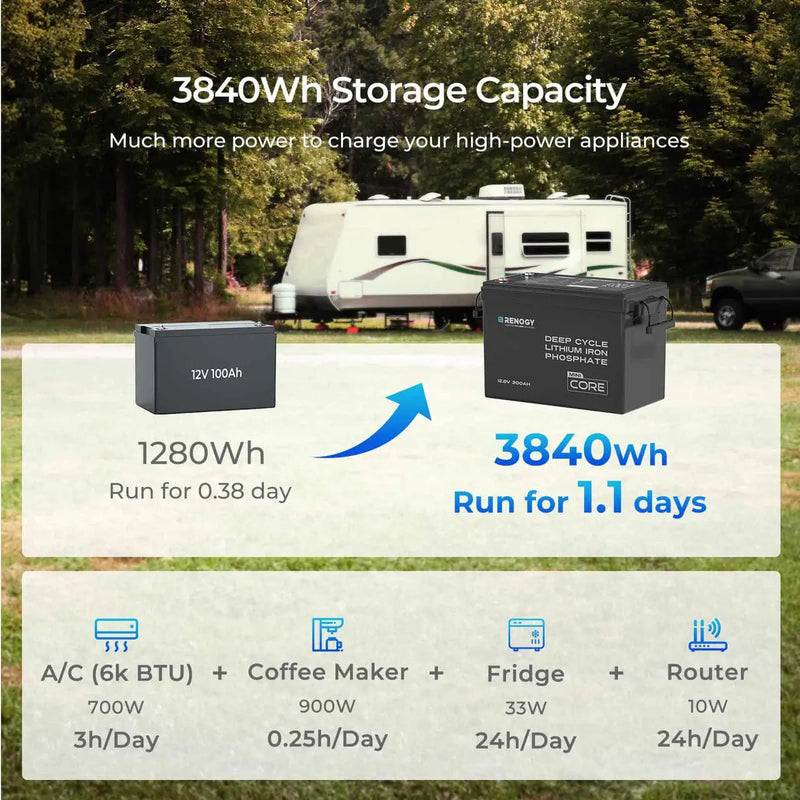
- Lighter than ever at 55.1 lb. 57% lighter than 12V 200Ah lead-acid.
- 3840Wh capacity. Max 4P4S, expandable to 61.44kWh.
- Low-temperature protection (charge <32°F, discharge < -4°F).
3. Renogy Pro S1 12V 120Ah / 240Ah LiFePO4 Battery
Renogy Pro S1 series LiFePO4 batteries can steadily deliver over 3000W output to run 99% of appliances in your motorhomes, such as air conditioners, coffee machines and hair dryers. Coupled with an ultra-long lifespan of 6,000 cycles (retaining 80% capacity), the Pro S1 series batteries can deliver 16+ years of reliable power with one full charge cycle per day. Plus, enjoy up to 7 years of warranty for long-term peace of mind.
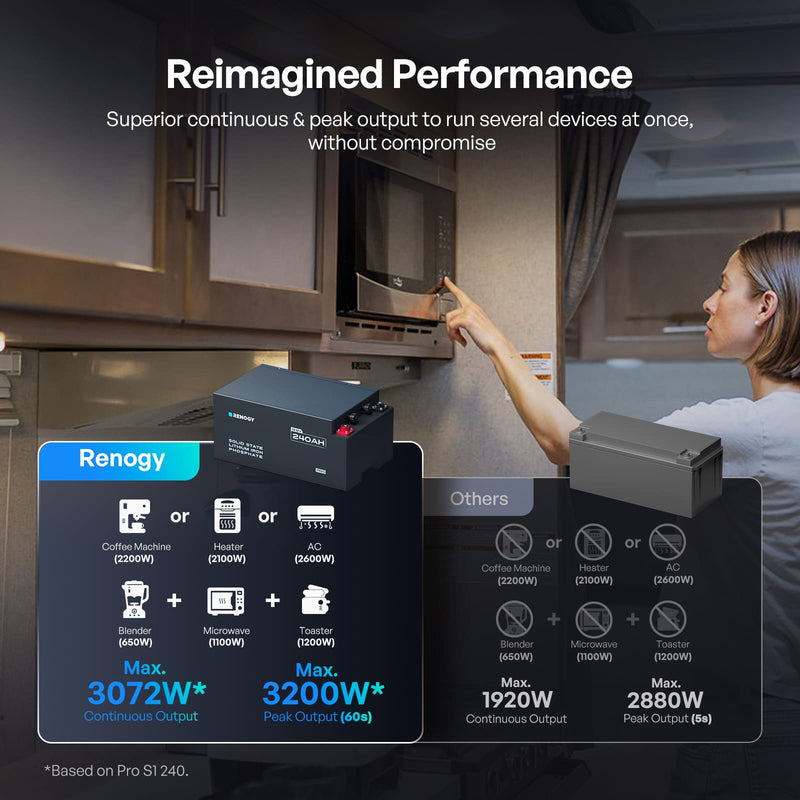
- Lighter than ever at 55.1 lb. 57% lighter than 12V 200Ah lead-acid.
- 3840Wh capacity. Max 4P4S, expandable to 61.44kWh.
- 1.6x longer Bluetooth range for easier remote monitoring.
Conclusion
Voltage chart is critical in determining the performance, energy density, capacity, and durability of Lithium-ion phosphate(LiFePo4) batteries. Remember to factor in SOC for accurate reading and interpretation of voltage. However, please abide by all safety precautions when dealing with all kinds of batteries and electrical connections.
FAQs about lifepo4 voltage
What is the most suitable LiFePO4 battery voltage?
The best voltage range is 13.2V to 13.2V. If you are not certain, always consult the voltage chart for accurate voltage. Ensure to maintain the voltage with this range for good health and longevity of LiFePO4 batteries.
How do I tell when my LiFePO4 battery is starting to malfunction?
Sure, your battery will not last a lifetime. But, it should give you good services for over ten years. However, if you notice any of these signs, it is an indication of a faulty battery.
- The battery takes abnormally longer to charge
- The battery does not charge at all
- It starts to swell up
- The devices power off while charging while there is a significant amount of charge in the battery.
What is the least damaging LiFePO4 battery voltage?
The minimum 12V LiFePO4 battery voltage damage is 10V. Discharging below the 10V minimum causes permanent and irreversible battery damage.


