


MPPT and PWM are the two main types of solar charge controllers. Both regulate the energy moving from solar panels to a battery, but they handle the panel voltage in different ways.
People often ask which one is better. The more useful question is whether the controller matches your solar panel voltage, battery voltage, system size, and installation conditions.
MPPT vs. PWM Charge Controllers: Quick Comparison
| Feature | MPPT charge controller | PWM charge controller |
|---|---|---|
| How it works | Tracks the solar array’s operating point and converts the available voltage and current for the battery | Regulates the connection between the solar panel and battery by switching the charging current |
| Best fit | Higher-output, higher-voltage, or expandable systems | Small and simple systems with closely matched panel and battery voltages |
| Panel-to-battery voltage matching | More flexible when panel voltage is higher than battery voltage | Works best when panel and battery voltages are closely matched |
| Energy-harvesting potential | Usually higher when operating conditions or voltage differences change | Can be effective when the system is simple and well matched |
| System complexity | More advanced power conversion and configuration | Simpler regulation and setup |
| Typical tradeoff | More flexibility, usually with a higher upfront cost | Simpler and more budget-conscious, with less flexibility |

What Is an MPPT Charge Controller?
MPPT stands for Maximum Power Point Tracking. An MPPT charge controller continuously tracks the operating point where the solar panels can produce the most usable power. It then converts the input voltage and current into a charging output that the battery can use.
This is useful because solar panels and batteries do not always operate at the same voltage. A solar panel array may produce power at a higher voltage than a 12V or 24V battery bank can accept directly. An MPPT controller helps bridge that difference instead of simply matching the battery voltage.
One simple way to picture it is to think of the solar panel as a pitcher and the battery as a cup with a narrower opening. An MPPT controller acts like a smart pourer: it adjusts the flow so more of the energy available from the panel reaches the battery at a useful voltage. It does not create extra energy; it helps make better use of what the panel is already producing.
When is an MPPT charge controller a good fit?
An MPPT charge controller is often worth considering when:
- The solar panel voltage is higher than the battery voltage
- The solar array is larger or may be expanded later
- The system has longer PV cable runs
- Sunlight and temperature conditions change throughout the day
- Collecting more usable solar energy matters more than choosing the simplest controller
MPPT does not remove the need to check system limits. The controller still has a maximum PV input voltage, maximum charging current, and maximum supported solar array size.
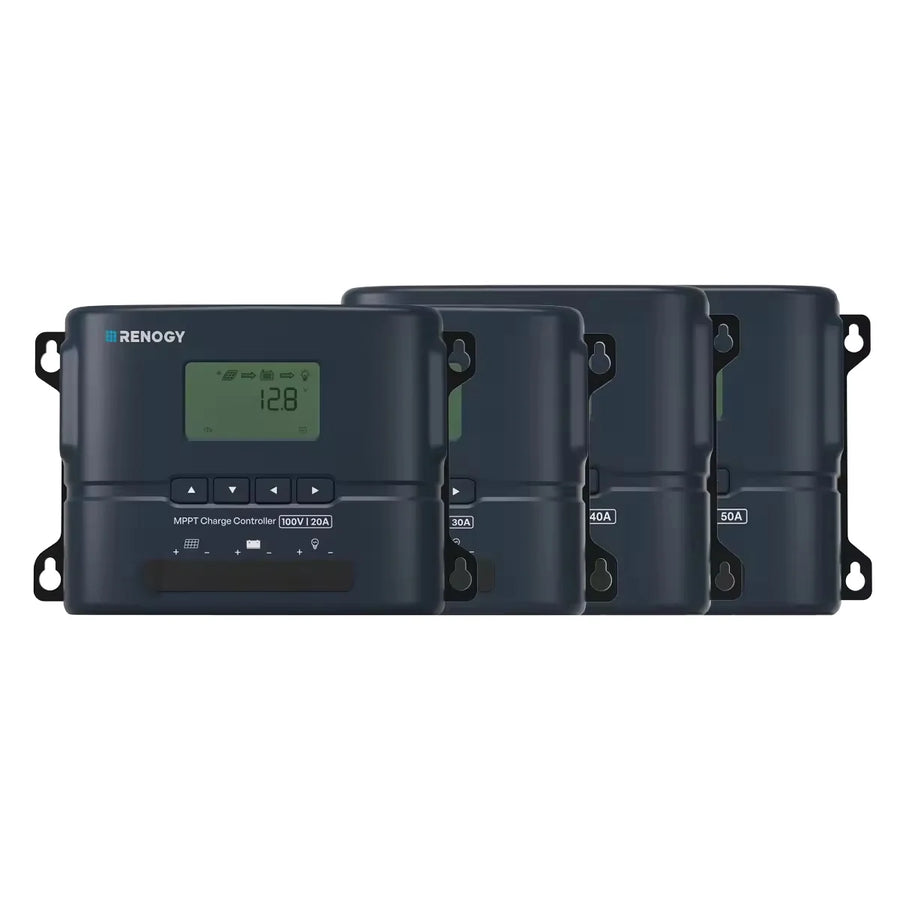
For a current Renogy example, the Rover 2 MPPT charge controller is designed for 12V and 24V systems and includes built-in Bluetooth for monitoring through the Renogy App.
What Is a PWM Charge Controller?
PWM stands for Pulse Width Modulation. A PWM charge controller regulates charging by rapidly switching the connection between the solar panel and the battery. As the battery approaches its charging setpoint, the controller adjusts the pulses to control the energy going into the battery.
A PWM controller is more dependent on the relationship between the solar panel voltage and the battery voltage. When those voltages are appropriately matched, PWM can be a practical choice for a smaller and simpler solar system.
A simple way to think about PWM is as a valve between the solar panel and the battery. It opens and closes the flow to keep the battery at the right charging level, rather than converting a higher panel voltage into a different charging output.
When is a PWM charge controller a good fit?
A PWM charge controller may make sense when:
- The system is small and straightforward
- The solar panel and battery voltages are closely matched
- The PV cable run is relatively short
- The system does not need much room for future expansion
- A simpler, lower-cost setup is preferred
PWM is not automatically the wrong choice for a small solar system. The important part is confirming that the panel, battery, controller, and wiring are compatible.
How Do MPPT and PWM Perform in Different Conditions?
Efficiency and energy harvest
MPPT controllers generally have more energy-harvesting potential when there is a meaningful voltage difference between the solar array and the battery, or when sunlight and temperature conditions change throughout the day.
PWM controllers can perform well when the panel voltage is closely matched to the battery voltage. In that situation, the additional conversion flexibility of MPPT may not be necessary for the system’s goals.
Panel and battery voltage matching
Voltage matching is one of the most important differences between the two technologies.
A PWM controller connects the solar panel and battery more directly, so the panel voltage needs to be appropriate for the battery system. An MPPT controller can convert a higher panel voltage into a lower battery charging voltage, provided the array stays within the controller’s input limits.
System size and installation conditions
MPPT is often the better option for a larger, expandable, or higher-voltage array. It can also be useful when the panels are installed farther from the battery and the system needs more flexibility in how the array is configured.
PWM can still be a sensible option for a small RV, van, cabin, or backup system where the array is simple and the panel-to-battery voltage relationship is already appropriate.

For a more detailed side-by-side explanation, read how solar charge controller types work or continue to size your solar charge controller.
Which Is Better: MPPT or PWM?
There is no universal winner. The better controller is the one that fits the solar array and battery bank without exceeding the system’s limits.
| Choose MPPT when... | Choose PWM when... |
|---|---|
| The solar panel voltage is higher than the battery voltage | The panel and battery voltages are closely matched |
| The array is larger or may expand later | The system is small and simple |
| You want more flexibility in panel configuration | You want straightforward regulation |
| Energy harvesting matters more than the lowest upfront cost | A simpler and more budget-conscious setup is the priority |
| The system may experience changing temperatures or sunlight | The system operates under predictable conditions |
Rover 2 MPPT vs. Wanderer Li PWM: What Changes in Practice?
The difference becomes easier to understand when you compare actual products. The Rover 2 and Wanderer Li are both Renogy solar charge controllers, but they are designed around different system requirements.
| Feature | Rover 2 MPPT | Wanderer Li 30A PWM |
|---|---|---|
| Controller type | MPPT | PWM |
| System focus | 12V and 24V systems | Optimized for 12V battery systems |
| Available versions discussed here | 20A and 30A | 30A |
| Maximum PV input voltage | 100VDC | 25VDC |
| Maximum PV input power | 20A: 300W at 12V or 600W at 24V 30A: 450W at 12V or 900W at 24V |
Up to 400W for the 12V system configuration |
| Monitoring | Built-in Bluetooth, LCD, and RS485 communication | RS232 communication with optional BT-1 Bluetooth module |
| Charging approach | Converts the solar input to the battery’s charging requirements | Uses four-stage PWM charging with closely matched panel and battery voltage |
| Best practical fit | Higher-voltage, more flexible, or expandable 12V/24V systems | Smaller 12V systems with a simple, well-matched solar array |
The practical difference is not simply that one controller is newer or more powerful. Rover 2 gives the installer more room to work with panel voltage and includes built-in Bluetooth monitoring. Wanderer Li is a simpler PWM option for a more closely matched 12V setup and may use an optional BT-1 module when remote monitoring is needed.
Always confirm the final panel configuration, battery settings, connection order, and protection requirements in the Rover 2 User Manual or the Wanderer Li User Manual.
How to Size an MPPT or PWM Charge Controller
Charge controller sizing depends on more than the controller’s amp rating. Before choosing a model, confirm:
- Battery bank voltage
- Battery chemistry and required charging profile
- Solar array operating voltage
- Solar array open-circuit voltage
- Total solar array current and power
- Controller maximum input voltage and charging current
- Future expansion plans
For MPPT controllers, make sure the array’s maximum voltage stays below the controller’s input limit, including the effect of low temperatures. For PWM controllers, pay close attention to panel-to-battery voltage matching and array current.
Use the solar charge controller sizing guide for the full calculation process.
Common MPPT and PWM Charge Controller Mistakes
- Choosing a controller by amperage alone
- Exceeding the controller’s maximum PV input voltage
- Using a PWM controller with a poorly matched panel voltage
- Ignoring the battery’s charging profile
- Assuming an MPPT controller can accept an unlimited solar array
- Connecting the solar panels before the battery when the manual requires the battery to be connected first
- Connecting AC appliances directly to the charge controller’s DC load output
Mount the controller and size the cables according to the product manual. A controller also needs adequate ventilation and appropriate overcurrent protection.
MPPT vs. PWM Charge Controller FAQs
Is MPPT better than PWM?
MPPT is often more flexible and can collect more usable energy when the solar panel voltage is higher than the battery voltage. PWM can be the better fit for a small system with closely matched panel and battery voltages.
Can an MPPT charge controller work with a 12V battery?
Yes, if the MPPT charge controller supports a 12V battery system and the solar array stays within its input limits. Always check the controller’s voltage, current, and battery compatibility specifications.
What is a PWM charge controller best for?
A PWM charge controller is commonly used for small and simple solar systems where the solar panel and battery voltages are appropriately matched.
Do PWM and MPPT charge controllers work with lithium batteries?
Some PWM and MPPT charge controllers support lithium batteries, but the controller must provide a compatible lithium charging profile. Check the product page and manual before connecting a lithium battery.
Does an MPPT charge controller always produce more power?
Not necessarily. MPPT has greater energy-harvesting potential under certain voltage, temperature, and sunlight conditions, but the actual result depends on the complete solar and battery system.
Final Takeaway
MPPT and PWM charge controllers both regulate solar charging, but they suit different system designs. MPPT is usually the more flexible choice for higher-voltage, larger, or expandable systems. PWM remains a practical option for smaller systems where the panel and battery voltages are closely matched.
Start with the battery voltage and solar array specifications, then choose the controller type that fits the way the system will actually be used.


