

Countless benefits of solar energy and the rising demand have convinced home and business owners to save on their electricity bills by going solar. The trend of shifting to solar power has become more popular these days. A huge percentage of US citizens have installed solar power systems on their homes and offices, and millions of others are planning to do the same in the near future.
It is a fact that a solar system can save you money on your utility bills, but a wrong-size system may lead to several issues, including system failure, unexpected costs, and inefficiencies. Therefore, before you invest in solar technology, understanding proper system sizing is crucial. In this article, you will learn how to size a solar system like a pro.
How to Calculate Solar System Size
A solar system consists of several components, including solar panels, an inverter, a charge controller, and batteries (optional). It involves a series of steps, as listed and explained in detail below.
Step 1: Analyze Your Energy Consumption
Understanding the amount of power you use yearly, monthly, or daily is important. Your electricity bills can help you analyze your average energy consumption (kWh) in a month.
All you need to do is sum up the monthly consumption throughout the year and divide the answer by 12 to find the average monthly consumption. Then, divide the answer by 30 to calculate your average daily energy consumption. If you want to get more detailed insights, use smart meters or other energy monitoring devices.
Step 2: Decide Your Battery Storage
If you live in a completely off-grid environment, you should consider solar systems with enough battery storage to fulfill your energy needs. Similarly, if you live in an area that faces frequent power outages, bad weather conditions, or a frequently cloudy atmosphere, install solar systems with batteries as a backup source.
When it comes to calculating the right battery size for your solar system, the formula below will lend you a helping hand.
Battery size (kWh) = daily use x days of autonomy / (battery efficiency x depth of discharge)
Example: Your daily energy consumption is 20 kWh. You want 3 days of backup with lithium batteries that have 90% efficiency and 80% DoD.
Battery size (kWh) = 20 x 3 / (0.9 x 0.8) = 83.3 kWh
It means you should have a battery bank with 84 kWh capacity.
Tips. Renogy Solar Calculator
If you prefer a faster way, Renogy offers free online tools to help you size the solar system you require. Simply select your setup, whether it is for an RV, Tiny Home, Boat, or a Building Roof and then choose the appliances and time you need. Our calculators will recommend the right solar kit size in seconds.
👉 Try the solar calculator based on different scenarios:

Step 3: Consider Peak Sun Hours
Peak sun hours are the number of hours per day when sunlight is strong enough for your solar panels to work at full power. This number is critical because you use it in the next step to calculate your array size.
You can find this data by searching online. Most places get between 3 to 6 peak sun hours per day depending on the season and geographical position.
One thing you should consider when deciding on a place to install solar panels is that there is no shading from buildings, trees, or other tall objects. Moreover, poor installation angle, bird droppings, and dirt accumulation may reduce your system's performance.
Step 4: Calculate Your Required Solar Kit Size
Now that you know your daily energy consumption, you can determine how large your solar kit needs to be. You can easily calculate it by dividing your daily consumption by average peak sun hours, as shown in the formula below.
Size of a solar kit (kW) = Daily energy consumption (kWh) / Average daily peak sunlight hours
Suppose you consume 30 kWh/day and get six peak sun hours daily. In that case, you need a 5kW solar kit to meet your energy requirements.

Step 5: Consider System Efficiency Losses
No solar electric system is 100% efficient. The performance is usually affected by various factors, such as rising temperature, shading, and inverter losses. You can adjust losses depending on the system's efficiency.
Suppose your solar kit is 80% efficient. In that case, you will multiply the system size by 1.2 to accommodate losses. If you don't add a buffer as an extra capacity to account for losses, your system may not be able to meet your energy needs fully.
Charge Controller / Inverter Sizing
Now that you know how to calculate your daily, monthly, and yearly energy consumption, and the number of solar panels required for any system. It is time to choose the correct size solar charge controller or inverter for your system.
While choosing a charge controller, never forget to match its ratings with the voltage and current of your solar panels. MPPT controllers are good, as they are more efficient than PWM controllers, but are expensive at the same time.
Similarly, while selecting a solar inverter, make sure that its rating matches the solar array output. Ideally, the inverter rating should slightly exceed the total array output of your solar system.
Solar Kits Recommendations
If you prefer a ready-to-use solution, check out these complete solar kits. We have selected two reliable options for RV applications.
| Product ① RV Solar Kit | Product ② ShadowFlux Solar Kit |
|---|---|
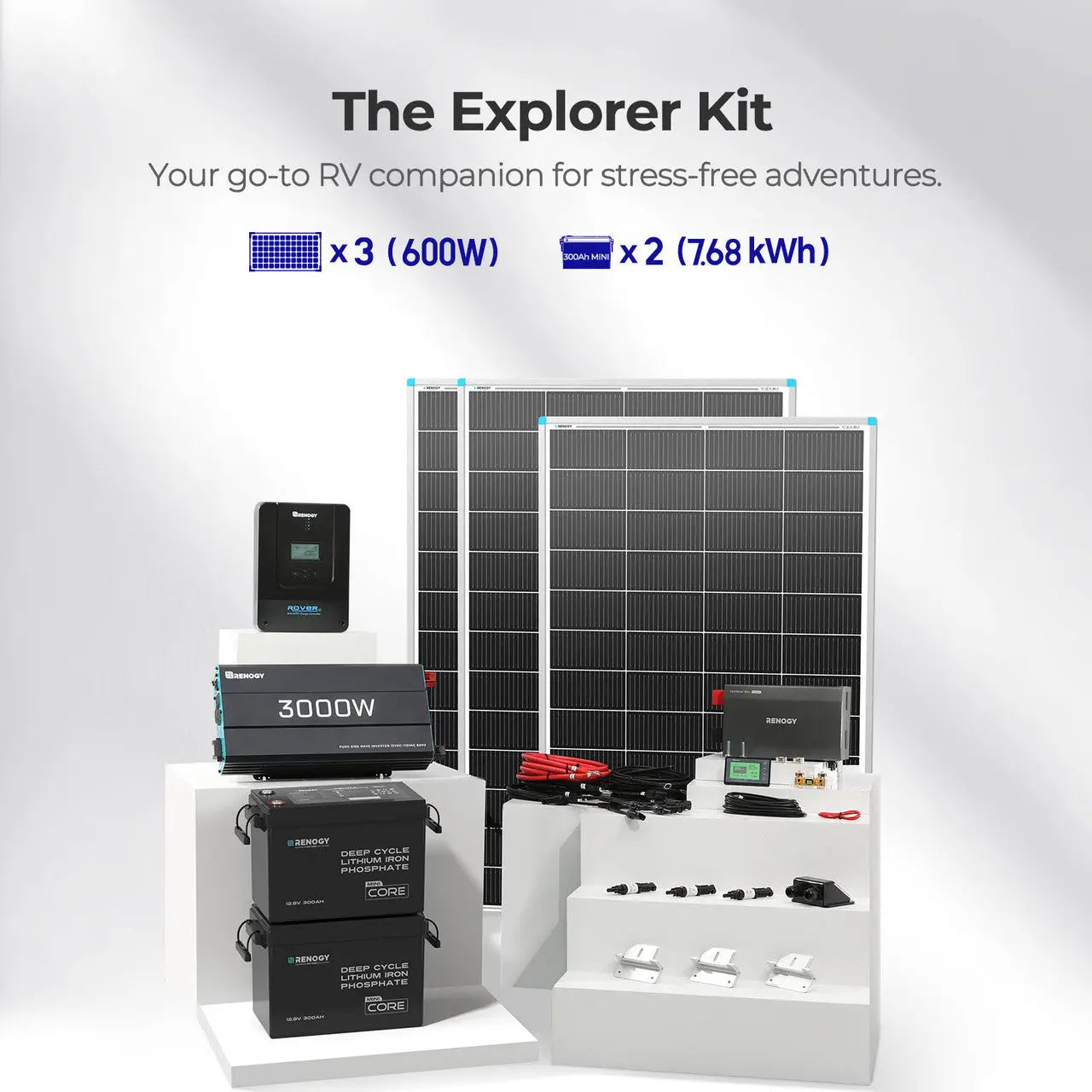 7.68kWh RV Solution 7.68kWh RV Solution
|
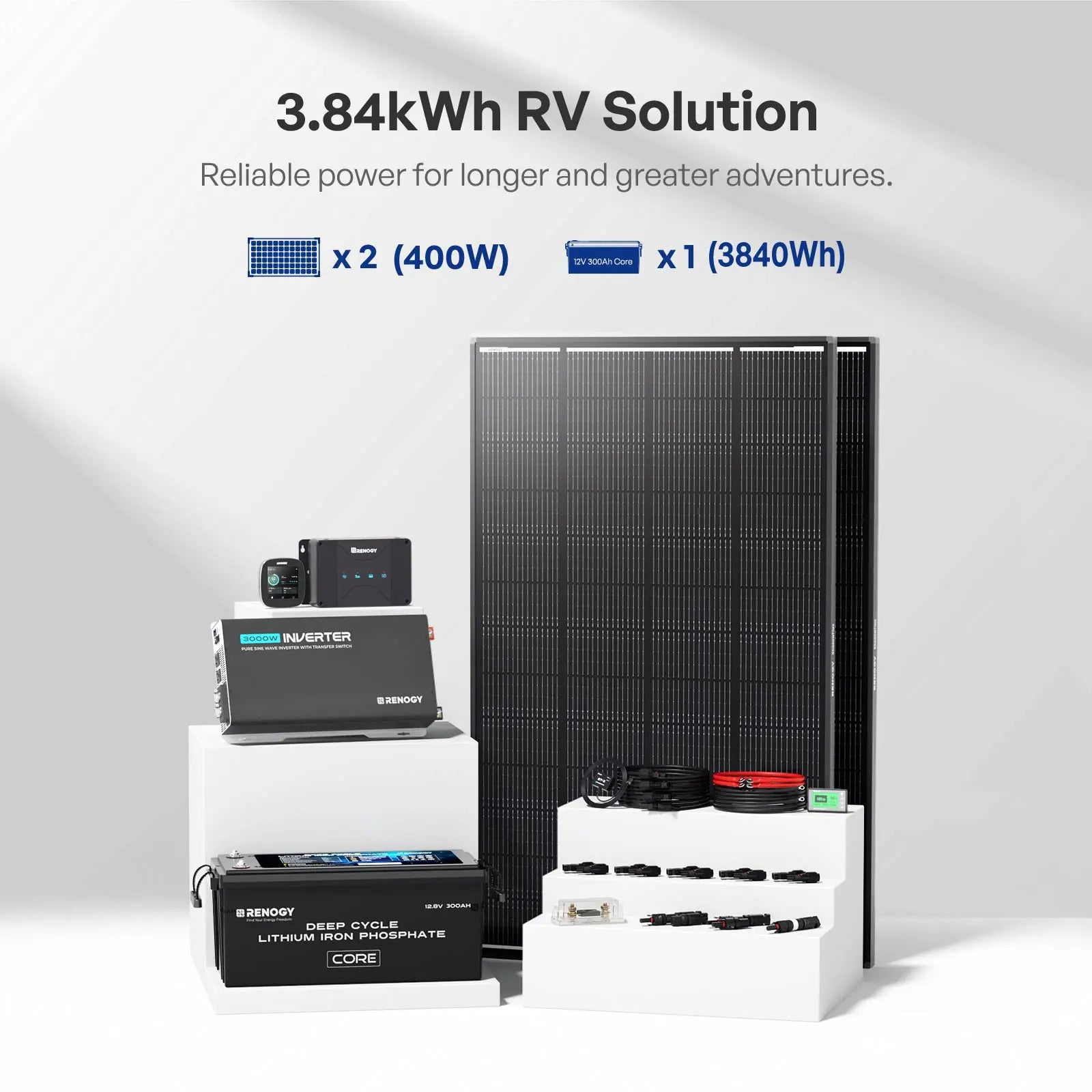 3.84kWh ShadowFlux RV Solution 3.84kWh ShadowFlux RV Solution
|
Additional Factors to Consider While Sizing Your Solar System
Apart from analyzing and calculating your energy consumption (kWh) and considering your location and solar potential, there are some other things to consider as well. Let's have a quick look at some of them.
- Seasonal Variations: Don't forget to consider this factor, as your system may perform differently in different seasons. Less sunlight decreases the overall performance of solar systems during winter.
- Roof Space: Make sure you have enough space on the roof while sizing a solar system.
- Incentives and Local Permits: Ask your utility company and municipality about the permits and licenses required to install a solar setup on your site.
- Net Metering: Consider installing a net meter on your location to ensure the excess energy goes to the grid and the grid supplies you with power when the solar system does not produce electricity.
- Future Expansion: If you have a plan to expand the system in the future to accommodate your increased energy requirements, consider it while sizing your solar system.
Final Thoughts
Wondering how to do solar panel sizing or solar system sizing? A couple of factors play a key role in determining the correct size for your system. They include your daily, monthly, or annual energy consumption, geographical location, solar potential, roof space, net metering, and performance variations during different seasons.
If you need assistance with sizing a solar system, the discussion above has presented a comprehensive step-by-step guide. It talks about sizing solar panels, an inverter, a solar charger controller, and the battery storage. If you need cost-effective and reliable solar equipment that lasts longer, explore an unmatched collection available at Renogy.
FAQs about Sizing Solar System
Is sizing an off-grid solar system different than sizing a grid-tied system?
Yes, both systems need different sizing strategies. Off-grid solar power systems should be larger to meet all of your energy requirements. They must have extra capacity to store excess energy in batteries and for cloudy weather. In contrast, grid-tied solar systems can be smaller, as they have the utility grid as a backup source of energy.
Can I size a solar system without batteries?
Yes, you can size a grid-tied solar system, as it does not need batteries as a backup source of power. You can consider local solar production estimates and your average daily/monthly electricity usage. Though a grid-tied solar system does not give you full independence, it significantly reduces your electricity bills.
Can I trust online solar system size calculators while sizing my home solar system?
Well, you can get some good estimates from these online calculators, but they may not consider all factors, such as appliance efficiency, local weather conditions, shading, and consumption changes in the future. Therefore, it is always recommended to have a professional site assessment to ensure precise system sizing.


