

An inverter charger is a key component in RV, marine, and off-grid power systems, combining the functions of a power inverter and a battery charger in one device.
What Is an Inverter Charger?
An inverter charger converts DC electricity from batteries or solar panels into AC power for household appliances, allowing you to run everyday appliances from your home solar panel kits or onboard battery system.. When an AC source such as a generator or grid power is available, it automatically switches to charging mode, converting AC to DC to recharge the batteries.
- Automatically switches between AC and DC power
- Powers appliances while charging batteries
- Supports solar, generator, and grid inputs
- Provides uninterrupted power during outages
In off-grid or backup systems, inverter chargers ensure reliable power by managing energy flow efficiently and can even start a generator automatically when battery levels run low.
As a charger, it accepts AC power from sources like the grid or a generator and converts it back into DC to recharge the batteries. Most inverter chargers include built-in battery chargers, monitoring systems, remote controls, and an automatic transfer switch to manage this process seamlessly.
In addition, many inverter chargers can automatically start a generator when battery levels drop too low, ensuring uninterrupted power in off-grid and backup applications.

Types of Inverter Chargers
There are two major types of inverter chargers:
- Pure sine wave inverter chargers.
- Modified sine wave inverter chargers.
What Is the Difference Between a 2000 Watt and 3000-Watt Inverter Charger?
The primary difference between a 3000W and 2000W inverter charger is their capacity. 3000W models offer 50% more continuous power, allowing higher simultaneous loads (e.g., air conditioners, microwaves, coffee makers) and higher peak surge (typically 6000W vs. 4000W). 3000W units require thicker cabling (e.g., 4 AWG vs. 2 AWG) and a larger battery bank to handle the higher amperage draw.
The maximum and continuous loads will decide the size of the inverter. The size of the battery will only tell you how long the inverter can draw that load before it drains the battery. There is no direct link between the two.
If all other factors are the same, choose the 300W inverter. At a specific load, a bigger inverter will often operate quieter. (And, then, you have the additional power if you require it.)
The only disadvantage of the bigger unit is that it may require an additional 500ma of current while idle and on without a load (which isn't a big deal).

How Many Amps Does a 2000W Inverter Draw
A 2,000-watt inverter charger typically draws about 83 amps at full continuous load with proper ventilation.
- Surge current: Up to ~186 amps for a brief moment
- When it happens: Starting inductive loads like motors or refrigerators
- No-load consumption: Around 1.5 amps (≈36W)
Always check the manufacturer’s specifications for exact continuous, surge, and no-load power ratings.
What Can a 2000 Watt Inverter Run?
If the power supply output of a 2,000W inverter is not maxed, it may be utilized as a power backup solution in the house, camper, or RV for utilities such as lights, freezer, computers, DVD player, camera, and other devices.
If you're using the inverter to run several gadgets, ensure the overall load doesn't surpass the inverter charger's continuous and peak power ratings.
To prevent inverter damage, only connect appliances that consume up to 80% of the inverter's maximum power rating.
To minimize inverter damage, only load up to 1,600W if it is classed at 2,000W. A few inverters can offer maximum output for a limited amount of time!
Tweak the number of devices and their operating voltage, then examine the total appliance load to understand which appliances may be linked to an inverter depending on its power rating.

How Many Amps Does a 3000W Inverter Draw?
Inverters exist in various sizes, but they all perform the same task in a solar power system; convert direct current to alternating current, which AC appliances and gadgets can then use. But how much current does a 3000-watt inverter draw? Is your inverter big enough to handle your system's amps? Or do you need to invest in a more robust system?
When a source is connected to an inverter, it begins to draw amps. Use the below formula to calculate the amps:
Amps drawn = watt load / input voltage / inverter efficiency
For example, a 3000W inverter on a 230V load with an 85% efficiency will draw 15.3 amps
What Can a 3000-Watt Pure Sine Wave Inverter Run?
The 3000W inverter has a steady power output of 3000 watts and a peak power output of 6000 watts, making it ideal for 12V automobiles, cabins, Caravans, and off-grid installations. This 3000W inverter supports a single heavy load of 3000 watts in an aviation socket.
A 3000-watts inverter supports DC input voltages of 12V/24V/48V/86V/110V and AC output voltages of 120V/230V and 50hz or 60hz. The 3000W inverter can operate at full load for extended periods while also providing power protection.
For the best 3000W inverter charger in the market, try Renogy's 12V Pure Sine Wave Inverter Charger w/ LCD Display. This inverter is compatible with most batteries, and it's also programmable to fit custom batteries.
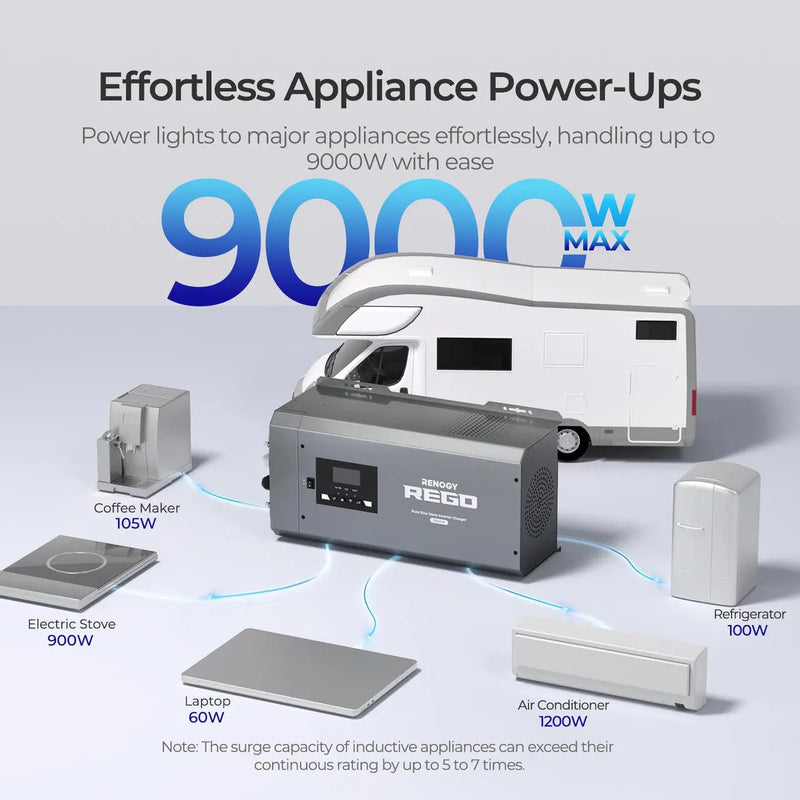
Renogy's 3000W inverter also has a 90% efficiency, a surge power of 9000W, and a four-stage battery charging system to ensure your battery charges 100% every time.
It also has a grid equivalent to AC power to protect your appliances from frying out.
With Renogy's 300W inverter charge, you can rest easy knowing you can power all through when you are off-grid and indoors. This inverter is unrivaled in the market and is even more affordable than other less efficient inverters.
Browse current solar deals and see how much you can save today!
What Size Inverter Chargers Do I Need?
Before purchasing an inverter charger, determine what size inverter charger you want so that you may get a device that supports a wide range of appliances.
Watts are the unit of measurement for power inverters. It must be capable of running the AC components attached to it at any given moment.
You should install an inverter charger with a rating that is roughly 25% greater than the most power-hungry device you want to install.
Assume you have a 240-watt slow cooker, a 200-watt blender, and a 300-watt television.
To operate them simultaneously, the camper's electrical system requires a significantly larger inverter than if you only use one at a time.
What to Look for When Purchasing an Inverter Charger
Even after you've estimated the required size, you should consider other elements of the product's specification and functionality before choosing your final selection.
Range of Input Voltage
If you're a frequent traveler, select an input voltage that corresponds to where you'll be spending most of your time.
Output Voltage
This is the current that the battery charger will deliver to the battery. A 12v battery bank is found in most RV and camper electronic wiring. Purchase an inverter charger with an output power that matches the voltage of your battery bank.
Efficiency Rating
Inverter charger efficiency determines how much power is lost during conversion. For example, a unit rated at 90% efficiency consumes about 10% more power than it delivers. Higher efficiency means less heat, lower current loss, and reduced drain from the power source.
This matters most at campsites where AC hook-up power is limited. If a campground outlet is capped at 25 amps, that supply must power both your inverter charger and all connected appliances. When an efficient inverter charger draws only 7 amps, you still have 18 amps available for devices like TVs or air conditioners.
A less efficient charger may draw 8–9 amps, leaving less usable power and increasing the risk of tripped breakers. Some models, such as Renogy’s 3000W inverter charger, include a control panel that lets you limit input current. This prioritizes appliances first and uses only the remaining power to charge batteries, helping prevent overloads and power interruptions.
Maximum Charge Current
This is the highest amp that the device can produce. It's the inverter charger size determined by your battery packs and load. This must be large enough to fulfill your requirements.
Charging Algorithm
The charging algorithm indicates the number of phases in the battery system.
Battery Compatibility
Most inverter chargers, though not all, are interoperable with AGM, lithium, and Gel batteries, but check before purchasing.
Transfer Switch
This handy function is available on several inverter chargers. If the mains' power fails, they immediately switch to another AC source.
Continuous Power
A 1000w inverter charger can give a constant voltage of 1000w, which means it can deliver this much power as long as the DC power is adequate.
Power Rating
The component may also generate a higher power surge in brief bursts related to the inverter function.
This is particularly handy for equipment like compressor refrigerators that require a power spike to start up.
They require a massive power boost to begin running.
The peak energy score of an inverter charger is frequently higher than the constant power rating.
For any peak demand, check the appliance's parameters.
Power Quality
The term "power quality" relates to the current and resonance stability. An inverter with poor power quality may produce a harsh voltage waveform. In a high-power generator, such as those present in an electric fan or vacuum pump, this instability will result in severe jerking and rattling.
Insensitive electrical appliances, and poor power quality is an issue. It has the potential to fry out circuits in smartphones' motherboards. High power quality is required if smart gadgets or medical equipment are to be plugged into the inverter.
Safety Features
Inverter chargers include built-in safety mechanisms that provide further peace of mind and preserve the van's electrical system.
They differ from product to product, but here's a rundown of the most frequent ones:
- High-speed ventilation fans to maintain the inverter at a cool temperature.
- Protection is provided by a Ground-Fault Circuit Interrupter (GFCI)
What Size Do I Need for My Camper Inverter?
First, you’ll need to determine which items you want to power simultaneously, since this will help you calculate the size of camper inverter you’ll need. Begin by listing all of the electronics in your RV and adding the watts required. You should consider the operating watts as well as the surge requirements, as some appliances have high surges when they first startup. Once you’ve calculated the number of watts you’ll need to power (including the surges) , add 20%. This will tell you the minimum size camper inverter you’ll need to power your devices.
You can easily estimate the size camper power inverter you’ll need by adding up the largest number of watts you’ll be using at a given time and adding 20%. Assume you require 1,500 watts to power your PC and microwave at the same time. 1500 Plus 300 (which is 20% of 1500) equals 1800 watts. This implies you'll need a camper power inverter with at least 2000 watts. The most frequent size used in RVs is a 2000 watt or 3000 watt unit.
Conclusion
A 3000W inverter charger is the best option if you are looking for a reliable solution. You might not have the appliances to fully utilize all the power that a 3000W inverter charger produces, but you never know when you will need it.
Furthermore, a high efficiency, high wattage inverter lasts longer since it works quieter and colder when connected with loads that are not equivalent to its wattage.


