

An RV inverter converts DC power into usable AC electricity to run everyday devices in your RV—like phones, laptops, and household appliances. In this guide, we’ll break down what does an inverter do in RV, what size you need, and key considerations for rv inverter installation, so you can confidently power your rig off-grid.
What Does RV Inverter do?
RV electrical systems use two types of power:
1. Direct Current (DC)
2. Alternating Current (AC)
DC power typically comes from batteries or solar panels, while AC power is what runs household appliances when plugged into a wall outlet.
So, what does an inverter do in a camper?
An RV inverter converts DC electricity from your battery bank or solar array into AC power that standard appliances can use. Without an inverter, you wouldn’t be able to run most household electronics while off-grid.
If you’re planning boondocking trips or energy upgrades, understanding how to install an inverter in an RV is essential for building a reliable mobile power system.
There are many inverter options on the market, but RV-specific models from trusted brands like Renogy are designed for mobile power demands and off-grid reliability.
In short: if someone asks, “what does a power inverter do on an RV?”—it makes off-grid AC power possible.
How Does an RV Inverter Work?
An RV inverter is engineered specifically for mobile environments and fluctuating power loads.
Key design advantages include:
1. Compact sizing for space-limited RV installations
2. Reinforced construction to handle vibration, movement, and travel conditions
Functionally, it works like any inverter—converting DC power from your house batteries or solar panels into AC electricity to run devices such as TVs, laptops, refrigerators, and microwaves.

The amount of AC power available depends on your battery bank and solar capacity, which creates practical limits such as:
● How many devices you can run simultaneously
● Whether you can power high-wattage appliances like air conditioners or cooktops
This is why proper system sizing—and planning how to install a power inverter in an RV—matters before upgrading.
To extend runtime, you can expand your battery bank or add solar panels. Just keep in mind this requires more installation space and adds weight to your RV.
How to Choose the Right Inverter Size for Your RV
Choosing the correct RV inverter size starts with understanding your power needs. Before selecting a unit, make sure you can answer the following questions:
1. What is your total wattage requirement (including surge loads)?
2. How many devices do you plan to run at the same time?
3. What types of appliances will you be powering?
4. Do you have enough installation space for the inverter?
5. What is the capacity and type of your battery or backup DC power source?
6. Which appliance has the highest power demand?
Follow these steps to size the right inverter for your RV:
● Step 1: List all electronic devices that will run on the inverter, including their running watts and surge watts.
● Step 2: Add together the continuous running wattage and peak surge wattage of all devices.
● Step 3: Multiply the total by 1.2 to add a 20% safety margin that accounts for system fluctuations.
● Step 4: After determining wattage, choose between a modified sine wave inverter and a pure sine wave inverter. Some appliances—such as microwaves, TVs, and radios—may not operate properly on modified sine wave power. In these cases, a pure sine wave inverter is recommended.
● Step 5: Measure the installation space where the inverter will be mounted. Use these dimensions to confirm proper fit and ventilation clearance.
Key inverter specifications to understand:
1) Power Rating: The total wattage the inverter can produce and sustain.
2) DC Input Voltage & AC Output Voltage: Input DC voltage is the power source the inverter converts into AC output. In the U.S., most RV systems use 12V DC battery power converted into 120V AC electricity to run appliances like TVs and motors. Always match the inverter to your battery voltage—never connect mismatched DC inputs.
3) Efficiency: Inverter efficiency measures how much DC power is successfully converted into AC power versus energy lost during conversion. Based on efficiency and waveform quality, inverters fall into three main categories:
i) Pure Sine Wave Inverters: The most efficient and premium option. They safely power sensitive electronics such as microwaves, televisions, audio equipment, and medical devices.
ii) Modified Sine Wave Inverters: A mid-tier option suitable for simpler electronics. However, they may not perform well with CRT TVs, compressors, laser printers, or certain audio/video equipment.
iii) Square Wave Inverters: The least efficient type and generally not recommended due to limited compatibility and potential safety concerns.
Watch our video “How to Choose the Right RV Inverter Size” to learn more. You can also use our online RV solar calculator to quickly determine the best inverter size for your setup.
Recommended RV Inverter Charger
If you’re planning an RV inverter installation, choosing a reliable inverter is key to powering AC appliances and managing battery charging efficiently. Renogy offers a range of RV-ready solar inverters built with practical features like power-saving mode, Bluetooth monitoring, and durable internal components.
The 3000W inverter (inverter-only) works well for running standard AC devices. However, if you want combined inverter + charging functionality, a 2000W inverter charger or 3000W model provides a more integrated off-grid power solution.
- Flexible battery compatibility: Supports multiple battery types for diverse RV power systems.
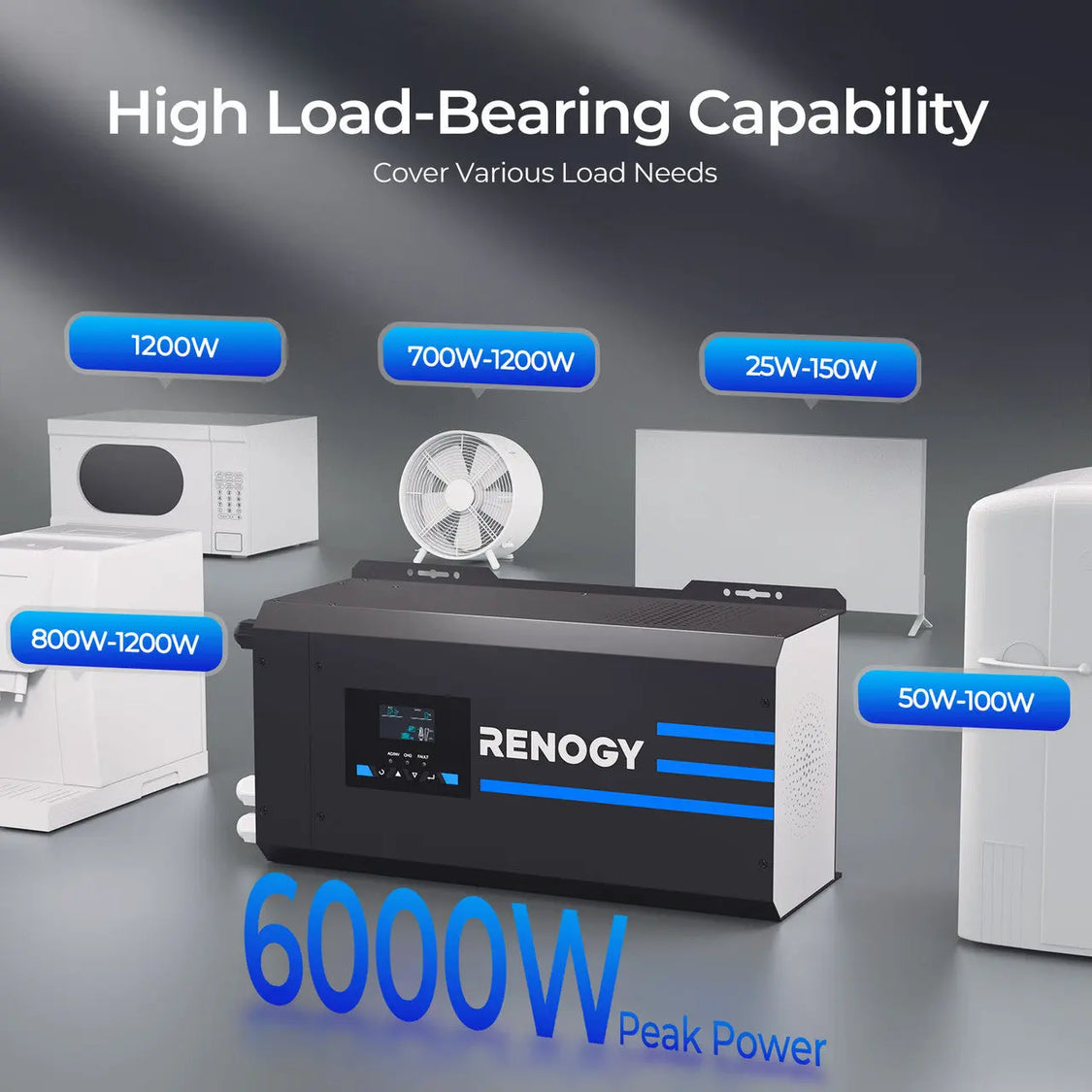
- 6000W peak surge output: Handles startup loads with ~90% conversion efficiency.
- Pure sine wave AC: Delivers clean, grid-like power safe for sensitive electronics.
- 4-stage smart charging: Optimizes battery performance and extends service life.
- Built-in safety protections: Guards against overload, overheating, and short circuits.
- Remote control capability: Includes wired remote switch with 16.4 ft cable for convenient system control.
- Rugged build: Designed for mobile/off-grid environments. Dimensions: 20.1 × 11.2 × 7.6 in (510 × 285 × 193 mm).
How to Install an Inverter for Camper
How do you install a power inverter in a camper? Once you’ve purchased your RV inverter, installation can begin. Contrary to popular belief, installing an inverter in your camper or motorhome isn’t difficult if you have basic DIY skills. Most of the tools required are easy to source. Below is a list of equipment and tools needed for RV inverter installation:
1. RV inverter
2. Multimeter
3. Red and black battery cables
4. Fuse
5. Screwdrivers
6. Wrench
7. Fireproof box or mounting base
8. Wire strippers
9. Cable ties or clamps
10. Fasteners
Attempting installation without the proper tools can pose serious risks to both your safety and your equipment. Follow these step-by-step instructions to install your RV inverter correctly:
● Step 1: Clear and prepare the area where the inverter will be mounted.
● Step 2: Secure the inverter in place, ensuring adequate ventilation space between the unit and surrounding surfaces.
● Step 3: Disconnect all power sources in the RV, including solar panels, shore power, and generators. Use a multimeter to confirm that all power has been fully shut off.
● Step 4: Connect the red and black cables to the positive and negative battery terminals. Then complete the wiring connections as shown in the diagram below.
● Step 5: After tightening all connections, switch on the battery isolator to test the inverter.
● Step 6: Power on the inverter. It should now be operating normally.

Do I Need an Inverter for My RV?
For many RV owners, an inverter has become an essential part of modern mobile living.
You’ll likely need an RV inverter if any of the following apply:
● You want to run TVs or other AC appliances while off-grid.
● You want to turn your RV into a comfortable, home-like space with modern electronics.
● You’re looking for a cleaner, quieter, and more cost-effective alternative to generators.
On the other hand, if you can live without most household appliances, an inverter may not be strictly necessary—but it does limit convenience.
Without an inverter, your RV won’t be able to power many common household devices. At minimum, a small RV inverter is recommended for charging essentials like phones, cameras, and laptops.
Some RVs now come with factory-installed inverters.
How can you tell if your RV already has one installed?
If your 120V AC outlets only work when the generator is running—and stop working once the generator is off—then your RV does not have an inverter installed.
How Much Does an RV Inverter Cost?
The cost of an RV inverter typically ranges from $100 to over $2,000, depending on size, features, and performance level.
As you can see, the price range is wide and is influenced by four main factors:
1. Inverter size and power capacity
2. Features (LCD display, remote control, monitoring, etc.)
3. Brand reputation
4. Performance (durability, reliability, and efficiency)
Renogy inverters range in price from around $124 to nearly $800, offering strong performance and value across multiple RV power needs.
Can an Inverter Power an Entire RV?
Yes—an inverter can power your entire RV, provided you choose the correct size.
The key is proper system sizing. An undersized inverter won’t handle your load demand, while an oversized inverter may waste energy.
To run a full RV electrical system on a single inverter, choose a unit with slightly more capacity than your calculated load—ideally at least 20% higher than your actual power requirement.
Can You Run Multiple Inverters at the Same Time?
Yes, you can run multiple inverters simultaneously.
When installing power inverters in an RV, multiple units can be connected in parallel to increase total power output. Higher output allows you to run more appliances at once.
The trade-off is faster battery drain.
Think of it like fuel in a tank: one vehicle can travel the full distance, but two vehicles sharing the same fuel can carry more cargo—while traveling a shorter distance.
Similarly, using two or more inverters will consume battery power more quickly, but it enables you to operate more AC devices.
RV Inverter vs. RV Converter: What’s the Difference?
Inverters and converters perform opposite functions.
An RV inverter converts DC (direct current) power from batteries or solar panels into AC (alternating current) power for household appliances. An RV converter does the reverse—it converts AC shore power into DC power.

Key differences include:
● Inverters power AC appliances, while converters power DC systems.
● Inverters draw energy from batteries; converters draw from shore power.
● Converters can charge batteries; inverters cannot—they only discharge them.
Pure Sine Wave vs. Modified Sine Wave
If you’re planning to buy an RV inverter, it’s essential to understand the difference between pure sine wave and modified sine wave inverters.
Purchasing the wrong type can affect appliance performance.
Pure sine wave inverters produce an electrical waveform nearly identical to utility grid power. This allows sensitive electronics to run smoothly without performance issues.

In contrast, modified sine wave inverters generate a stepped waveform rather than a smooth curve.
This can negatively affect sensitive electronics. Devices may malfunction, suffer damage, or produce audible humming noises.

If you plan to run sensitive electronics such as TVs or audio equipment, we recommend using a pure sine wave inverter.
Modified sine wave inverters can still power many basic devices, including:
● CRT televisions
● Water pumps
● Device chargers
Learn more about the benefits of pure vs. modified sine wave inverters here.
Is an RV Inverter Worth It?
For many RV owners, investing in an inverter is absolutely worth it due to the wide range of benefits it provides.
● Enables use of free solar energy
● Reduces long-term energy costs
● Quieter and cleaner than generators
● Provides portable power anywhere
● Compact and RV-friendly design
These advantages are only the beginning. Once installed, most RV owners discover new conveniences every day.
So, is an RV inverter worth buying?
If you want to enjoy a modern, comfortable RV lifestyle, an inverter is one of the most valuable upgrades you can make.


